Showing posts with label Maintenance. Show all posts

Thursday, September 8, 2016

AC Trouble

The air conditioning in my stateroom isn't working... again!

What?!?! You ask. How are you surviving in 93 degree heat with 49% humidity and very few windows that open?

Easy. I say. I have three other air conditioners.

Boats like mine are the best for having multi-zone HVAC systems. The units are spread throughout the boat: one in the main stateroom, one in the guest stateroom, and two on opposite ends of the salon. It's great. We can have a nice cool stateroom for sleeping without wasting energy cooling the rest of our home. The AC in the forward (guest) stateroom is rarely turned on because the room is closed off from the cats, the blinds are drawn, and we spend little time in there. In fact, I just checked, the forward stateroom is currently 83 degrees without AC at 3pm on a hot Baltimore day.

When I go to bed tonight, my stateroom won't be as cool as I want it to be, but it will be comfortable.
See that red circle, those two windows lead into the head attached to my stateroom. The stateroom spans the entire stern of the boat. So, while I don't have working AC, I do have things in my favor:
  1. My stateroom is down a couple steps from the salon and we all know heat rises.
  2. I have a fan running on the far side of the stateroom circulating air and helping that hot air find its way out of the room.
  3. Part of the stateroom is below the waterline which helps keep it cool (think about your basement in the summer).
  4. One of the units that cools the salon has a small vent in the master head.
I should be okay for one more night until we get a chance to solve the issue. We may have growth in our AC water strainer. That's been happening a lot this year and it restricts the amount of water going through the system. With all the debris in the water from the recent storms, we may have sucked up a plastic bag (as we've done before) that is also restricting water flow. My hope for now is that the other units continue working until tomorrow.

Living on a boat still beats living on land in my mind.

Monday, April 20, 2015

Two Year Anniversary!

We've done it! We've been onboard for two years now.

When we first made the decision we promised each other that we would give this lifestyle at least three years. We weren't allowed to give up after the first winter no matter how bad it got.

And now? Two winters (and two glorious springs, summers, and autumns) later? We can't imagine going back to a non-floating residence.

Check out all that we have accomplished in 730 days:

Interior Renovations/Redecorating
Exterior Maintenance, Safeguards, and Fun
  • The purchase of an ice-eater to protect us during an extremely cold Baltimore winter.
  • Winter water prep and protection of outdoor pipes.
  • A Lehr propane motor for the dinghy.
  • Four short hauls.
  • A few days "on the hard."
  • A new name.
  • Figuring out how to change the oil, fuel filters, impellers on the engines and generator.
  • Four new house batteries.
  • A couple fresh coats of wax.
  • New LED lights (with the option of blue or white).
  • Replacement helm stereo, speakers, and a new TV.
  • New valves for the VacuFlush system.
  • Repair of one holding tank sensor and replacement of the other (aren't you glad there aren't pictures of that?).
  • Using Starbrite Waterproofing to seal the canvas against leaks.
Marina Celebrations, Activities, and Community
Trips
  • We ventured to Annapolis, Fairlee Creek, Kent Narrows, Rock Hall, Saint Michaels, Seneca Creek, Sparrows Point, Stevensville, Sue Creek, and Tolchester for a total of 125 engine and 457 generator hours.
Curious what other projects boaters are tackling? Take a look at this list from Chicago liveaboards after their first year: http://waterwethinking.blogspot.com/2015/05/what-have-you-done-we-made-it-one-year.html?showComment=1432224545986

Wednesday, October 8, 2014

Replacing the Water Heater

How big is your hot water heater? 40 gallons? 50 gallons? Mine is 11 gallons. Yes, that is correct, eleven. And it provides plenty of hot water for dishes, laundry, and showers (even for someone with long hair).

When we discovered that our hot water heater had a leak we jumped right into problem solving mode. Seriously, who wants to take a cold shower or even just wash their hands in cold water.

The leak was small. The stream of water was so fine it looked more like a spider web. The leak might not have been large but the water had good aim; it was spraying right onto an electrical box. This is where the Facebook Live Aboard Boats group came to our rescue. I put out a request for suggestions on a temporary fix and found out about JB Waterweld.
Sorry that I can't say exactly how long the patch lasted. We are fully aware that one leak just means that that the hot water heater is on its last leg. Our hope was that the leak would get us through a week or so while we researched new water heaters. I'm happy to say that it did its job.

This is where we ran into a snag. I know I bragged about my huge 11 gallon tank at the beginning of the post. Well, we actually started with a 20 gallon tank. The problem is that our water heater model is no longer being made and we struggled to find something else that would fit into the space allocated. Our old unit was tall and thin. Most of the units being made today are short and wide. After another plea for answers from the online group, we decided to take the plunge and purchase a smaller unit.
Old unit on the left. New unit on the right.
The new (smaller capacity) tank has been installed for a few months now and I really don't feel like I'm missing anything. I have literally stood in the shower waiting to see if the hot water would run out. I usually end up giving up when there is no end to warm water in sight. I often find myself wondering how I ever used all the hot water in a huge home tank.

So, how large is your hot water heater? And do you really think you need one that large?

Wednesday, April 9, 2014

Home Improvements

Now that we've been aboard for almost a year, we are ready to start making subtle changes to Luv'n Life IV based on personal preference, practical use of space, and things that need fixed. For example, our master stateroom had this stereo under the TV:
I love music more than the average person but I do not own any cassettes or CDs so this unit was all but useless to me. And since space is at a premium we could surely find a better use for the space. We took off the cover...
And discovered that the stereo and speakers were glued and strapped down but managed to remove them. Yuck! 10 year old dust!
Once everything was cleaned up it was like a beautiful, expansive piece of new real estate...
That was just the perfect size for the printer.
But the project didn't quite look complete. So we took the old cover:
And cut out the middle to create a "frame."
Part entertainment, part office, all practical:
Things also break on a 10-year-old boat. Doug tried but the leaky cold water faucet in the master head did not want to be fixed. We got to the point where we would only use hot water so we wouldn't have to mess with it. I don't mind brushing my teeth in warm water but found it mighty difficult to wash my face in water so hot I could barely touch it. (Plus, I really didn't like the gold accents on the current faucet and couldn't wait to switch it out.)
Luckily it came out just like the faucet in a house and we have a lovely, new, fully functional faucet.
Living on a boat isn't that different from living on land.

Tuesday, April 1, 2014

Back on Land

No, this isn't an April Fools' joke. Luv'n Life IV is on land at Tidewater Yacht Service for routine maintenance -- just imagine how hard it would be to paint the bottom while she was still in the water.

Whenever we've had a boat pulled in the past, we've brought it to the boat yard, gone to work the next day, and returned to a boat up on land. I've often wondered about the process and I have to give a huge thanks to the Tidewater staff for being so nice about me taking tons of pictures yesterday morning.

The first step is getting the boat out of the slip and into the lift using this little boat:
They just tied off to the bow and towed our boat through the marina:
And into the lift:
Once she was in the lift and out of the water, they scraped off barnacles and power-washed the bottom. We had her pulled twice last summer (July and August) so this was nothing new. Unlike those two short hauls, we couldn't just stay in the lift the whole time. This is where it gets interesting.

They take the lift with the boat to an available space in the yard:
Adjust the straps until the boat is level back-to-front and side-to-side:
Build up small wooden towers under the center line:
Play reverse-Jenga with more pieces of wood until they are all level before lowering the boat the final inch or so:
Add support poles:
Is everything level?
Loosen the straps on the lift:
Undo them at the center:
And drive off:
Ta-da! After 2 1/2 hours from start to finish, she's up on land for a couple days. I personally am in awe of the process.
Wondering where we are living? We didn't have to pack up anything as we are still living on the boat. We have access to power:
And slightly-harder-to-navigate-than-usual front steps:
We even have wildlife:
The view isn't as pretty as usual:


But we do have interesting neighbors:
Pending weather, we'll be back in the water within a couple of days.

Monday, August 12, 2013

Plastic Bag and Barnacle Attack

The title of this post sounds as scary as an attack by killer tomatoes or, perhaps, a land shark candy gram, but plastic bags and barnacles can be quite a nemesis for boaters. On Wednesday last week, our air conditioning started giving error codes and then quit altogether. The codes indicated that we were not getting enough water into the system to run it so we pulled apart the strainer and cleared it of barnacles (sorry, no pictures, I was busy scraping barnacles with a plastic knife). Problem solved? Unfortunately, no. So, we scheduled another haul out for the weekend and were lucky enough to get just enough water through the system to run the AC in our stateroom for a couple of days.

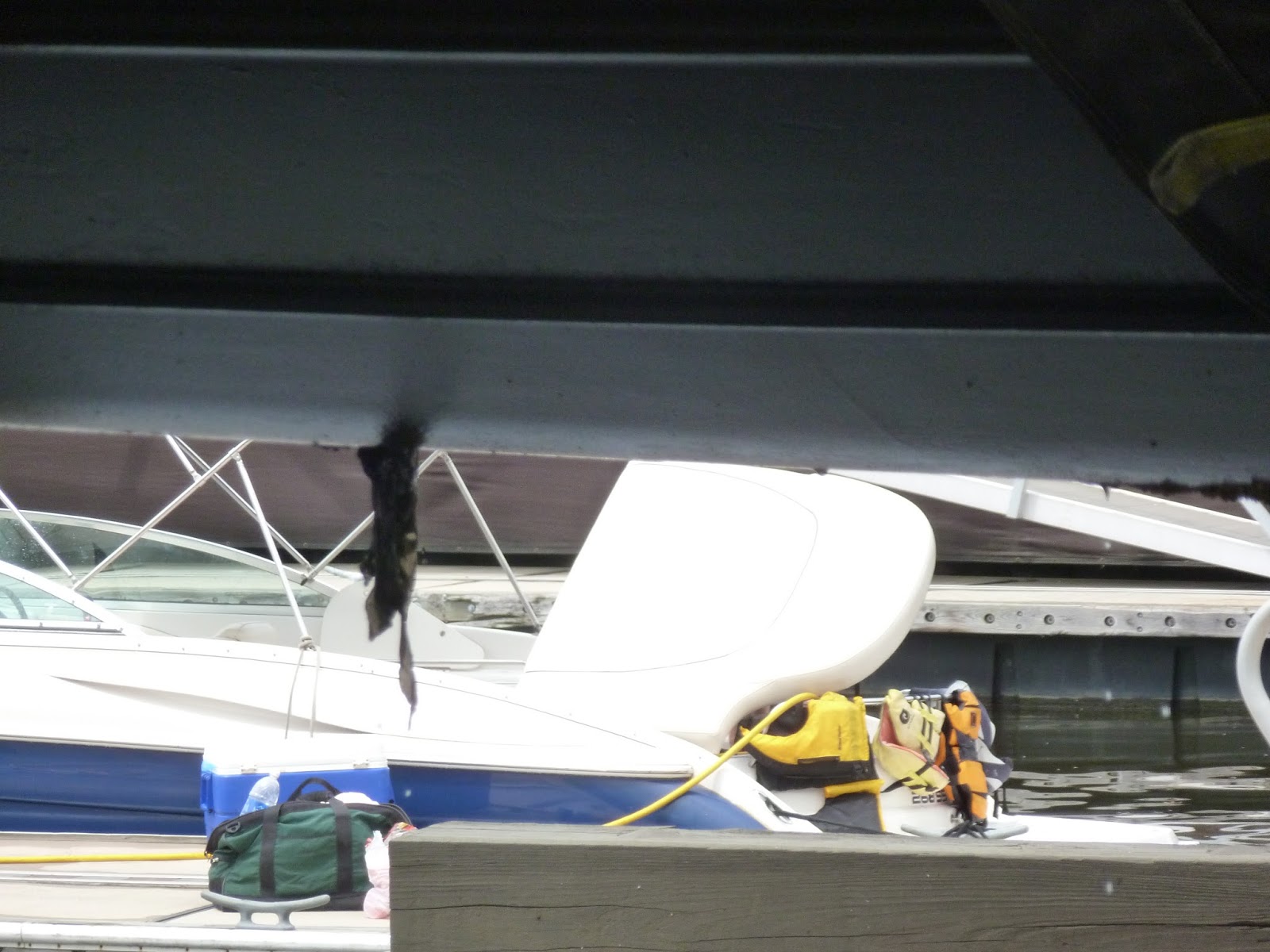
The culprit was evident as soon as the boat was out of the water:
Not the best picture of our stowaway plastic bag. The workers pulled it off before I could grab another shot.

The water intake for our air conditioning with barnacles as an unwanted accessory.
If you've never seen a barnacle, here is a super close photo. The outside area is hard like a shell and it grows with the organism inside. The photo is slightly misleading, the barnacles on our boat were no bigger than the tips of your fingers.
The bag was removed and everything was power washed and scraped.
Staff at our marina have heard that this is the worst year for barnacles in twelve years. Staff at the haul out facility said they have seen boats with brand new bottom paint come in covered in barnacles. (FYI - boats in the Bay are typically painted with a bottom paint that deters growth. Depending on the paint, how much the boat is used, and other various factors, this process is repeated every couple of years.)

So, how often do you have to remove living organisms from your house so everything will work properly?

On a positive note, I captained the boat out of the slip for the first time. I was more comfortable than I expected to feel and will continue to learn. The next step is docking and will require many deep breaths on that day.

Along that note, so many people have shared stories with us about the arguments and yelling between spouses while docking, leaving the slip, anchoring, etc. (some even say that divorces are caused because of it -- aren't boats supposed to be fun?). Communication while the boat is moving can be difficult. In a car, you can simply apply the brakes, pull over, and discuss how to drive the car. There are no brakes on a boat. If it isn't tied to a dock or successfully anchored, there is very little to keep it from moving. Decisions that must be made quickly and differences of opinion or understanding are not a good mix. Doug and I have been boating together for 13 1/2 years and had to learn how to communicate on a boat. While we aren't experts, our mutual understanding makes us good partners. We often discuss how we think the boat will react to the wind and current before pulling out of or into a slip or new situation and will debrief after both good and bad events. Is there an aspect of life with your partner that has taken years of communication trial and error?